Just One More Browser I Swear
October 23, 2025 | 1915 words | 9 min
A reflection on why browsers matter more than ever, and how Chrome, Arc, Zen, and Dia each shaped my workflow. This post examines what I truly value in a browser, why I switch so often, and where the future of browsing is headed.
This blog began as a reflection on why I frequently switch browsers. While drafting it, the browser landscape shifted rapidly. Atlassian acquired The Browser Company of New York, Firefox finally addressed long-standing CSS gradient issues, and Perplexity even made an “attempt” to buy Google Chrome amidst antitrust lawsuits. By the time I returned from a trip to Europe and got the time to revisit my writing, much of it already felt out of date.
That pace of change is exactly why the topic interests me. Browsers have become central productivity tools for myself, not just windows into the web, and the differences between them genuinely affect how I work day to day. In this post, I’ll outline what I look for in a browser, why I move between them so often, and where I think browsers and browser standards are heading from here.
Why browsers matter now more than ever
Most of the tools I rely on throughout the day now run in a browser; docs, source control, CI dashboards, project boards, chat, analytics, it’s all there. It didn’t happen all at once, but over the last decade more and more of these tools moved into the browser. At some point, it stopped being just one app among many and became the environment everything else passes through.
Since the early 2010s, the rapid growth of SaaS has pushed more of our tools into the browser. Figma, Jira, GitHub, and countless others adopted a web-first model, making software available instantly through a browser instead of an install. As that pattern repeated, the browser didn’t just become another app, it became the default gateway for getting work done, particularly in the tech world.
When the browser becomes the place where work happens, it stops being a neutral choice. Decisions in UX, performance, tab management, extensions, and navigation now have a meaningful effect on my day, and likely yours too. When a browser gets those decisions wrong, the pain shows up constantly, not occasionally. You interact with it hundreds of times per day, so small issues compound, but that also makes it one of the biggest levers for improving how you work. A browser can now accelerate your workflow or get in its way.
AI has the potential to be one of the most disruptive technologies of our time, and the browser is likely to become one of its biggest distribution layers. That dynamic opens the door for both new players like Dia and ChatGPT Atlas, as well as entrenched incumbents such as Google and Microsoft who already control major entry points. But today’s browser-based AI is still early in the cycle. They’re mostly question-answer copilots sitting beside your tabs, not systems that take meaningful action.
The real shift will come when AI can act on what’s in the browser, not just talk about it. When that happens, your browser becomes an action environment instead of just a workspace, and the choice you make will matter even more than it does now. AI might reshape the browser in the future, but until that happens, the only thing that really matters is how well a browser supports the workflow I have today. Over time I’ve learned what I actually value in a browser, and that’s where my real journey begins.
What I value in a browser
Over time, after bouncing between browser after browser, I realised I wasn’t switching for novelty or out of boredom. Each change happened for the same underlying reason: something in my workflow felt slower, heavier, or more frustrating than it needed to be. The browser wasn’t just another app, it was the environment I worked inside, and the friction I used to shrug off eventually made my values impossible to ignore. Each browser solved something I cared about and then revealed a flaw I couldn’t live with, so the only way to explain what I value now is to walk through the browsers I tried, why I switched to them, and why I left.
Chrome - the browser you already have
Like most people, I started on Chrome without thinking about it. It was the default, and at that stage I didn’t have “browser preferences”, I just opened tabs and went about my life. The first change came before university, when my laptop was struggling and YouTube stutter pushed me toward OperaGX. It felt smoother for a short while, but the gimmicks and bloat wore thin fast. Once performance slipped again, I dropped it and returned to Chrome.
It was only during university, and especially once I began working as a software engineer, that the browser became part of my actual workflow. Chrome was where I first discovered things like tab groups, profiles, and proper sync across devices. That’s when I started realising a browser could support or hinder how I worked, not just display websites. Chrome became my baseline: reliable, simple, and predictable. Eventually, though, that also became the problem. I wanted something more opinionated, something that actually tried to rethink how a browser should work. That curiosity is what led me to Arc.
Arc - a reimaging of the browser
Arc was the first browser that actually felt different. Not incremental, not “Chrome with an opinion,” but a genuine rethink of how working in a browser could feel. The moment I tried vertical tabs and Arc’s take on folders, something clicked. For the first time, managing a lot of open work didn’t feel like juggling, everything lived where it belonged, and switching contexts felt fluid instead of chaotic. Other browsers have attempted vertical tabs, but Arc tied the whole experience together in a way that made it feel natural, not bolted on.
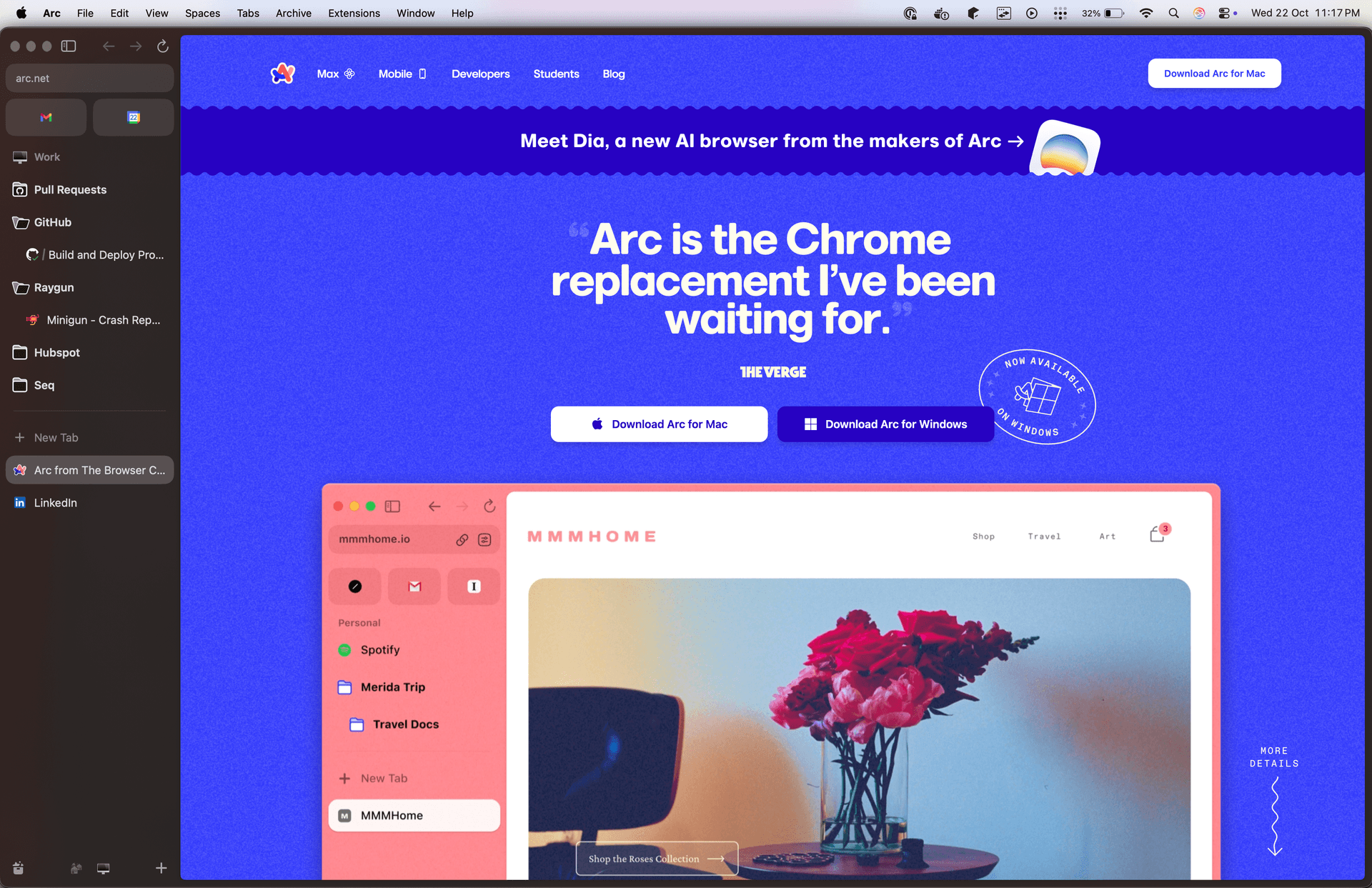
For a while, it was the most organised I had ever felt in a browser. Workspaces made sense. Pinned tabs actually stayed useful. Arc’s structure didn’t just display my work, it supported it. It was the first time I stopped thinking of a browser as a utility and started seeing it as a real part of my workflow, not just a window to it.
But the honeymoon didn’t last. On Windows, Arc always felt a step behind. Features landed slower, polish lagged the macOS version, and over time performance issues crept in. The momentum that made Arc exciting in the first place started to fade, and I found myself fighting friction again, only this time it stung more, because I had seen how good it could be. Eventually, I moved on. It wasn’t because the core ideas failed, but because the execution couldn’t consistently keep up with them.
Still, Arc changed my expectations of what a browser could be, and that stuck with me. Even after I left, I found myself chasing that same feeling, looking for a browser that had Arc’s ambition, without the trade-offs that pushed me away.
Zen: promise without polish
After leaving Arc, Zen was the first browser that genuinely caught my attention. It felt like a spiritual successor–lean, minimal, and built by people who clearly understood why Arc resonated with power users. And being open source, it carried a different kind of promise: a browser shaped by community needs rather than VC pressure. On paper, it was everything I wanted: Arc’s soul, without Arc’s baggage.
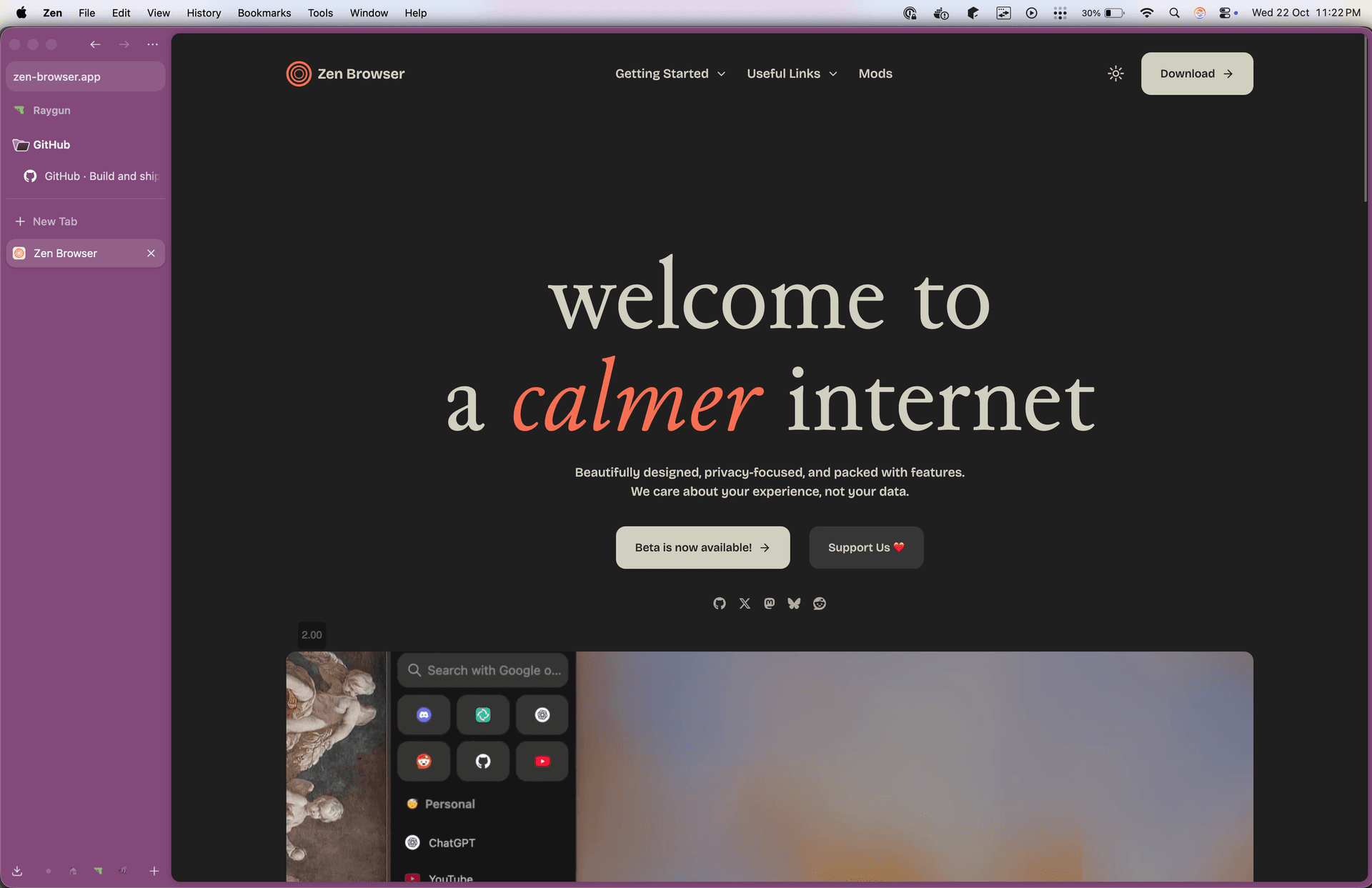
But the reality didn’t hold up in day-to-day use. Zen had the idea of Arc’s workflow, but not the execution. Firefox’s engine brought constant rough edges for developer workflows, sync across devices was weak, and over time performance on Windows began to regress in familiar ways, even after clean reinstalls. The biggest surprise was the lack of DRM support, which meant no Netflix or Disney+. For a long stretch they didn’t plan to support it at all, which made Zen feel principled in a way that clashed with practicality. In the end, Zen’s vision pulled me in, but its limitations pushed me out.
Zen taught me a clear lesson: understanding the problem isn’t enough, polish, performance, and platform maturity matter just as much as philosophy. I wanted something Arc-like, but I needed it to actually hold up under a real workload.
Dia: Arc's ideas, missing Arc's soul
Where Zen felt spiritual, Dia felt direct. It carried the unmistakable influence of Arc’s workflow concepts, and initially it seemed like it might deliver the structure and ambition I had been missing. Of all the AI-enabled browsers, Dia has taken the most credible swing at integrating AI in a way that respects actual work, not just novelty. My first impression was hopeful: maybe this was Arc’s vision, reborn with momentum.
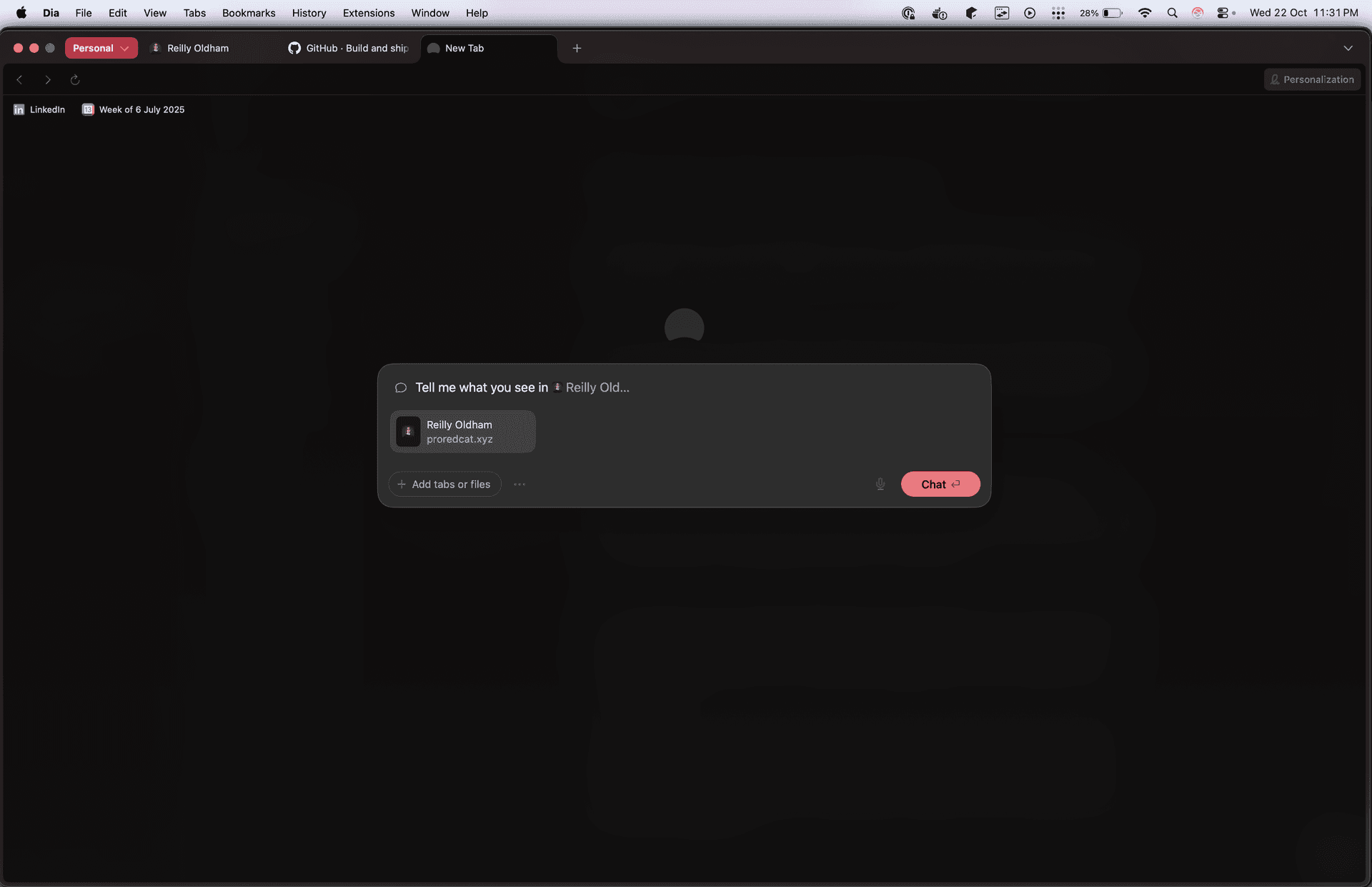
But the more I used it, the clearer the gap became. Even though vertical tabs eventually landed, they didn’t feel like Arc’s, they were just tabs turned sideways. The fluidity was gone, along with the sense of spatial organisation that originally hooked me. Other pieces were missing or less refined, and while Dia is polished, it still isn’t close to the clarity and UX cohesion Arc once had. And with the Atlassian acquisition, it’s no longer clear whether Dia will continue down the same path, or shift toward a very different set of priorities.
Dia ultimately reinforced the point that AI alone isn’t a reason to switch browsers. It has potential, but potential without the right opinionated design still misses what made Arc special. So I moved on once again, still chasing the browser that could finally deliver both vision and execution.
After all the switching, what I care about has turned out to be surprisingly simple: a browser that helps me stay organised, keeps context clear, and disappears into the flow of work. Fluid tabs, clean structure, and effortless performance aren’t luxuries, they’re the whole point.
Where I am today
Right now, Arc is the browser that fits me best, especially now that I work on macOS. I didn’t spend most of this journey on a Mac, but with my work setup there today, Arc finally delivers the experience I always wanted from it. The polish is there, the performance is smooth, and the workflow-first philosophy that hooked me in the first place actually holds up day to day. At home I’m still on Windows, and while Arc isn’t as refined there, I’m willing to tolerate the rough edges because I’ve seen how good it can feel on hardware and an OS it’s clearly built around.
The core strengths haven’t changed. Arc’s spatial approach to organising work, especially through vertical tabs and structured navigation, is still unmatched. The difference now is that I’m no longer fighting missing features, lagging parity, or half-shipped ideas. On macOS, Arc supports my momentum instead of interrupting it, and at this point in my workflow that matters more than any novelty a different browser could offer.
I’m not treating this as “the end of the journey,” and I’m not loyal to Arc in a permanent sense. But I’m also not switching for curiosity alone anymore. If I move again, it’ll be because something clearly supports how I think and work, better than what I have today. For now, Arc does that, and that’s enough.
Closing thoughts
Browsers are personal tools. For some, they’re just a window to the web; for me, they’ve become part of my workflow itself. I don’t think I’ve found the perfect browser yet, but I have found clarity on what I value, and that matters more than the switching. Whether the future comes from steady refinement or a bold reimagining, I’m optimistic. The browser still has room to grow.